Ingen varer i kurven.
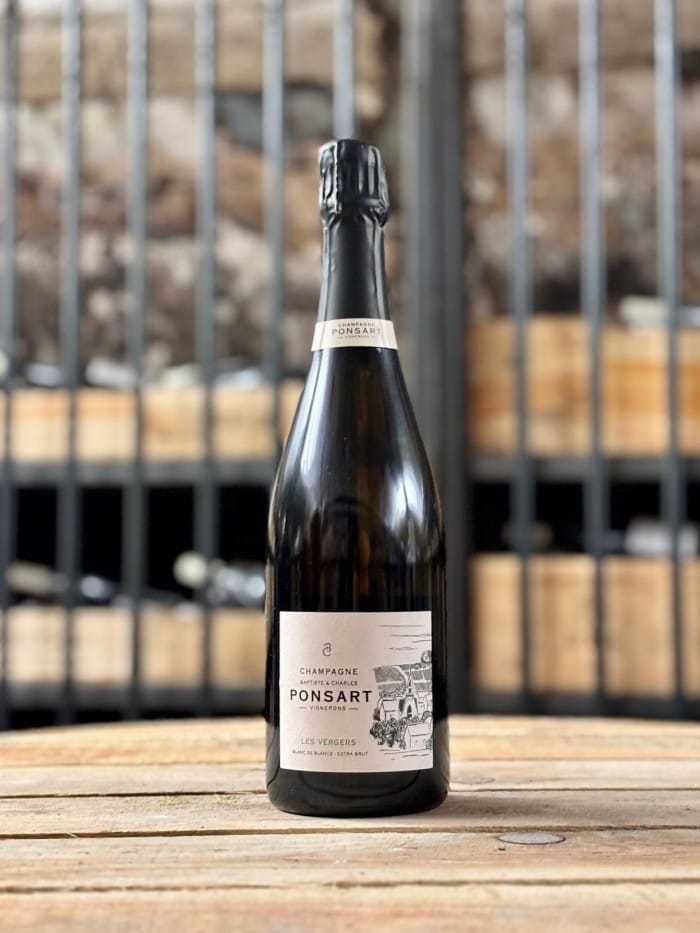
100 % chardonnay fra topmarken Les Vergers.
"Hailing from the 2022 vintage and disgorged in February 2026, Ponsart’s latest NV Extra-Brut Blanc de Blancs Les Vergers soars from the glass with aromas of orange oil, white flowers and quince, mingled with nuances of freshly baked bread. Medium- to full-bodied, vinous and muscular, it is built around a fleshy core of fruit and ripe yet racy acidity, animated by a pinpoint mousse and concluding with a zesty finish. Finished without dosage, it contains about four grams per liter of residual sugar, lending it a more giving style. As ever, it derives from Les Vergers, a south-facing parcel in Germigny characterized by clay-loam soils and planted in 1985."
595,00 kr.
På lager
B. & C. Ponsart er en familiedrevet vingård, hvor arbejdet i markerne er fundamentet for kvaliteten i flasken.
Arbejdet i marken foregår med stor omtanke og så skånsomt som muligt. Her prioriteres lavt udbytte, sund frugt og en naturlig balance i vinstokkene, så hver parcel får lov til at udtrykke sit eget særpræg.
I kælderen arbejder B. & C. Ponsart med en klassisk tilgang til vinifikation, kombineret med moderne præcision. Gæringen foregår med fokus på at bevare friskhed, struktur og druernes naturlige karakter. Resultatet er champagner med flot dybde, renhed og en markant mineralitet.
"Located in the village of Janvry, this 10-hectare estate, with vineyard holdings spread across 10 villages in the Montagne de Reims, is run today by Baptiste, Charles and Bertine Ponsart. The vines average 40 years of age and are planted predominantly to massal selections. Since 2016, Charles has overseen vinification, while Baptiste has taken charge of viticulture. Approximately 65% of their land is planted with Pinot Meunier, with the remainder almost evenly divided between Pinot Noir and Chardonnay.
No herbicides have been used since their grandparents tended the vines. While the family's viticultural history dates back to 1961, it was only a decade ago that they began producing wine under their own label, releasing their inaugural 500 bottles in 2018—the 2016 vintage of Les Vergers. Fruit is harvested at full phenolic ripeness, and chaptalization is avoided.
Until recently, vinification took place at the local cooperative—under their complete control, naturally. But 2025 marks a significant turning point with the completion of their own winery, equipped with an in-house press and dedicated spaces for fermentation and maturation. Élevage is conducted primarily in oak barrels ranging from 228 to 600 liters, employing a combination of new and previously used barrels, with the remainder taking place in stainless steel tanks. Sulfur is added only at pressing. Fermentation is driven by ambient yeasts, followed by complete malolactic conversion, and the wines remain on their lees for eight months.
These are vinous, muscular cuvées—wines of character and steady quality." - Wine Advocate